26 February 2007

Cycling: First Test for the "Mountain Challenge 2007", Bordighera - Seborga


The first test for the traditional annual cycling competition of the “Mountain Challenge 2007” from Bordighera to Seborga was won by Dell’Oriente for the Junior/Senior Category (1h 22’) and by Ginestra Flavio for the Veteran Category.
Like last year, the sixty competitors took part in the first of eight tests of the competition in bad weather, cycling through the Nervia valley, from Dolceacqua to Ospedaletti, Bordighera and finally to Seborga after tackling the never ending uphill road of 11 km. The next test is planned for Sunday 4 March, starting at Bordighera for the “Romana” circuit.

31 January 2007

Sanremo: Corso Fiorito 2007

From Jan 14 to Feb 04 the city of Sanremo hosts the “Sanremo in Fiore”, flower festival with the charm of the “Corso Fiorito”, the impressive parade of procession of floral floats. This is an annual event where all aspects of flora produced in the Ligurian Ponente (western Liguria) are exhibited, from evergreen plants, cacti, flowering plants to aromatic herbs.
It is an event not to be missed where one can immerse oneself in the thousands of colors and perfumes only to be found in the Sanremo area, thanks to its microclimate allowing them to be cultivated in winter.
“Corso Fiorito” is also an opportunity for the many flower growers in the area to compete against each other under a common theme (chosen by the organisers) with their best floral composition.
This year’s theme was the cartoon characters and for the challenge twelve towns and villages participated in the event that culminated with the floral parade last Sunday, 28 January.
This year winner, for the second consecutive year, was the town of Santo Stefano al Mare with the floral composition representing the “Pimpa” character (photo on top). Seborga participated with a floral float representing Diabolik character (photos on left).

The first edition of "Corso Fiorito" was held on January 1904 and was called "Festa della dea Flora" (Feast of Goddess Flora). There were "floral" carriages on which the "pioneers of flowers" showed their novelties. This event was so successful that it was held year after year and it also gave rise to the "Battle of Flowers" in which several floats were entirely covered with flowers. After the war, the parade was called "Italia in fiore" (Italy in bloom) and was accompanied by bands and folklore groups. Thanks to this parade, Sanremo thus became the Town of Flowers par excellence. Nowadays the “Corso Fiorito” is one the most important events in Sanremo and certainly the most eagerly awaited.
The preliminary phases last for several months, and then everything happens in one single night: from sunset to dawn the floats blossom thanks to the skill of the people who decorate them. Thousands of colourful flowers create marvellous compositions: faces, dresses, animals, clouds, stars and setting are all made up of flowers.
When the moon gives way to the break of day, the floats are ready. The feast can start. And the town streets are thus full of life - also thanks to the bands that accompany the parade every year.

New Premises for the Honorary Consulate in Castellarano (Italy)


The new premises of the Honorary Consulate of the Principality of Seborga in the Italian town of Castellarano (Reggio Emilia) will soon be officially opened.
Although there is not a final date yet, the opening will take place some time in February with a conference followed by refreshments.
The announcement came from Mr. Paolo Iotti, Honorary Consul who said that the new premises were provided by the city council as result of a specific agreement between the Principality of Seborga and the city.
The Honorary Consulate was instituted by decree by HRH Prince Giorgio Ist on 28 November 2001. The Consulate will host conferences and seminars of a historical, musical and artistic nature.
The new premises are located in Via Kennedy, 27 and the Consulate has activated a web site that can be visited at this address: www.beepworld.it/members/consolatoonorariodiseborga

Emergency Birth

On Friday 12 January, a woman resident in Seborga gave birth under emergency circumstances. When the labour started the woman realised that she could not reach the nearest hospital (20 km from Seborga) and an ambulance was sent to assist her in giving birth to a baby boy.
Since the Italian authorities decided to transfer the obstetrician department in the town of Sanremo, many children in the area have being born at home or in an ambulance. Mother and child are well.

23 December 2006

10 December 2006

Father Christmas In Moldova With The Seborga In The World Association

The Seborga in the World Association is planning a trip from 28 December to 4 January to Moldova. The plan is to distribute toys, clothing and other items to the many children of poor families in the town of Mihailovca and in the south of the country.
For this project many students from different school grades in the province of Imperia are involved in collecting the goods for these less fortunate.
This initiative has received support from the Italian Red Cross, UNICEF and the Moldova Embassy in Rome.
During this trip the volunteers of the association are also hoping to successfully transfer from Moldova to a hospital in Rome an 11 year old girl who is currently suffering from cerebral paralysis. This girl has not seen her mother (the only relative left) for the last two years since she started to work in Italy to cover the medical expenses.
The girl is presently in an orphanage and the organisers are hoping to have all the papers required by the bureaucracy to be able to transfer the girl to a hospital in Rome for proper treatment and to allow the mother to see her daughter again. If they succeed it will be a very special Christmas present for this small family.

The Tree Fete Is Back Again In Seborga And In The All Intemelia Community


The Intemelia Mountain Community together with the Italian Forestry Corps has recently re-established “The tree fete”: an old tradition well practised in the past in the region.
The aim of this initiative is the planting of 500 trees among the municipalities of the mountain community and for this purpose the organisers have requested the involvement of the students from various schools in the region.
The opening ceremony was held in Seborga where thirty elms were planted by the students of the primary school under the supervision of the Italian Forestry Corps.
After Seborga will be the time for the other villages with the planting of oaks, olives trees, pines and elms.

08 November 2006

HRH PRINCE GIORGIO Ist OF SEBORGA WILL NOT ABDICATE

It is official: HRH Prince Giorgio Ist will not abdicate!
The spokesperson for the Principality, Mr G. Pistone, has announced that the Prince has decided to remain in charge. “Given the insistence of his most faithful friends and of the entire population of Seborga – declared the spokesperson – HRH Prince Giorgio Ist has accepted to renounce his earlier decision to retire”.


When in January the Prince announced his intention to abdicate – a decision justified by his age (70 years old) rather than the quarrel with the mayor for the upgrading of the area in front the ancient Cistercians Church of Saint Bernardo as reported by some media - the news left everybody in Seborga numb and surprised and reached every corner of the world.
Radio, television and newspapers around the world reported the announcement with great prominence and many journalists from important newspapers and magazines came to Seborga to investigate the case.
Now, we welcome the news of His change of mind with great relief and happiness because it will certainly bring an order and stability which recent events and characters have threatened of late, upsetting the tranquillity of the place and the honesty of the Seborgans.
This episode, beside the glamour created, has demonstrated that the cause carried out during many years by the Prince Giorgio Ist for the recognition of the independence of Seborga, has gained support and attention never reached before.
The case of Seborga is not as some would have us believe merely a Soap Opera. Today, the case of Seborga is a reality that cannot be ignored and the international community is more aware and sympathetic.
Prince Giorgio Ist is loved by his subjects and admired more and more by people around the world that follow the events happening in this tiny Principality with a passion.
We are happy that Giorgio Ist has decided to keep holding the reins.
There is still lot to do before its time to dismount.
May God grant Him the strength, wisdom and the fighting spirit to continue. (R. C.)

21 October 2006

A Museum Of Modern Art In Seborga


The Municipality of Seborga has officially unveiled an ambitious proposal for the city and the Principality: the creation - with the collaboration of two German companies and an artist from Berlin - of a museum of modern art.
The Mayor of Seborga, Franco Fogliarini has declared that the two companies involved have already promised the funding for the project. The proposal is now going to be assessed for its feasibility but the Council is favourable to publicise the project and to make available the land for the construction of the museum.
The project is part of a series of initiatives for the cultural and tourist development of the Principality. The idea of a Museum in Seborga started from Germany. Heiko Sachse, a versatile artist from Berlin, long involved in the enhancement of the ancient noble traditions of Seborga, has declared that he will auction very soon (the date is yet to be decided) his painting of the rock star Madonna (see photo) in the Principality of Monte Carlo. The starting price for the auction will be 30 thousand euro and the sum collected will be devolved for the construction of the museum.
Heiko Sachse, an honorary citizen of Seborga, recently organized a special event for the 80th birthday of Queen Elisabeth II in Berlin. The event, titled: "The Royal Laser Symphony-Queen Elisabeth" involved a symphonic musical performance written by the artist and a spectacular laser show. Heiko Sachse is the author of several artworks regarding the royal family; many of them are exhibited at Buckingham Palace, St James Palace and Westminster Abbey.
The Municipality of Seborga has expressed gratitude and appreciation to the artist for his commitment in favour of the development of the Principality. The Counsel General of the Federal Republic of Germany in Milan has also expressed appreciation for the project of the museum that will be named: CUORI D'ORO (Golden Hearts).

06 October 2006

The History of Seborga in Piazza


For five weeks, every Wednesday evening starting at 21:00 in Piazza Saint Martin, the curator of the Seborga Historical Library and writer Sergio Pistone will hold a series of lectures about the history of the Principality of Seborga and how it evolved.
The topic of the first meeting (which took place last Wednesday) was on "the ancient people of the territory"; the next topic will be on "Christianity and the heretical doctrines". The meetings are open to the public and everybody is welcome to attend. (SeborgaPress)

23 September 2006

Principality of Seborga: An Historical Synthesis

In the remote prehistoric period the territory of the Ligurian Piedmont is populated by the Cro-Magnon man; in the Neolithic period, around 5000 years ago, an inhabitant of the place that today is called Seborga carves an idol of stone, while others chip away small stones to make some tools. In that period man has spread also to the islands, from the Balearics to Malta to the Peloponnesus and in all the Mediterranean.
For a millions of years man inhabits this area, this Ligurian Provenza, gifted with a fortunate climate that has allowed him to prevail over glacial periods. A Ligurian population, always settled in our mountains, made of rough, strong and patient men who, incredibly, love these stones, this barren and poor land.
Towards the end of the Bronze Age, 1250 - 1300 B.C., one small tribe, belonging to the Celtic world and coming from the Euro-Asian east, crosses the barrier of the Maritime Alps, comes down along the divide that from the Marguareis mountain descends to the sea at Bordighera and occupies the west side of the mountain.

In the mountains, and always on the western side, some important people are buried in large tombs. Among them, one burial ground gives this place the name of Seborga. The occupied territory, divided into four villages (today Castelvittorio, Baiardo, Perinaldo and Seborga) is governed by eight men, two from each village, who then elect a leader.

The eight faithful and their descendants settle in these places and near the main tomb: they guard it, they defend it and they make it a reason for living for thousands of years and more.
This tradition, of eight plus one, will continue for thousands of years to come, until the time of the establishment of the rules of the “Paupera Militia Christi” of Saint Bernard and the Order from which its name originates.

With some difficulties, the descendants of the original tribe become part of the Ligurian population and, in part, they adopt the local language and customs, maintaining at the same time their own. One of the words that they accept, typical of the Palaeolithic-Mediterranean language, is the name that is given to the place: Sepulcrum. This name will give the village a prerogative and a sacred role, never to be lost or forgotten.
The ancestors of present day Seborgans do not get involved in the Romano-Ligurian wars, indifferent to the object of the dispute: officially the creation of a coastal road that links Rome with Marseilles, but in practice the subjugation of the Ligurian people to Rome.

At the time of Jesus Christ and the early Christian church, Seborga, with all probability, is directly interested in the absurd issue of the siblings of Jesus. The particular affection that the Jews have for the Ligurian Provenza zone is clearly documented; the Romans themselves confirm this line of contact by exiling to the Rodano valley and the surrounding area the Jews who resist and revolt against Roman domination. With the crucifixion of Christ, begins the Diaspora of Christians to different parts of the world and, of course, in our mountains, where they meet the descendants of the Celtic tribes.

The two religions have great and fundamental points in common, among them the oneness of God; the immortality of the soul; an intermediate world in which, after the death of the body, the soul is weighed; respect for the saints; the refusal of the sacred representations (the iconoclasm); brotherly love for all; tolerance towards other religious beliefs; and also a particular preference for the sacral meaning of the numbers three and eight.

At this point a mechanism is released, still not clearly understood in its essence but surely linked to the name of the place. The village becomes the “SEPOLCRO” (Sepulchre) for a relic of such importance and sacredness that it cannot be named. From this moment forward, for two thousand years, the place of Seborga becomes sacred: no armies conquer it; no States aspire to it; no Monarchs claim it; and no one even wants to mention it!

With the passing of the centuries this distinctiveness remains unbroken and the reputation of Seborga, always coexisting with the secrecy of its location, is widely known in the Christian world but - it should be said - only at higher levels. The particular relationship between the village and the eastern Provenza continues and we see a period characterised by invasions, destruction and pillage; Seborga is always protected, nobody touches it.

The involvement of Ludovico the Pious and the formal creation of the Imperial Principality, with the nomination of the bishop Claudius as first Prince, will allow, through the documents and the parchments that survive to us, the writing of a well documented and authenticated history.

The events that follow “the gift” of Guidone confirm its authenticity, in spite of some difficulties in the interpretation of the document. The religious status of Seborga, even if apparently heretical (think of Saint Cassiano and Saint Bernard), is reaffirmed by the arrival of the Catar refugees.

Time moves on and we reach the second half of the 17th Century, with the minting of the coins of the Principality and the incredible story of the “selling” of the Principality by the Savoia Family. Even then the European turmoils do not touch the ancient Principality, which proves to be alien to the earthly disputes and always rightly ignored for its essentially religious status.

And now, in order to finish, the invention of the Reign of Italy, the fall of the monarchy, the short interval of uncertainty and, in 1963, the election of the Prince, H.R.H. George I, reconfirmed (together with the adoption of the General Statutes) 23 of April 1995.

Thus this short summary comes to an end, although some of the mysteries mentioned in this account remain to be explained: what happened to the Seborga documents taken by Genoa; the exact nature of the sacred relic buried, who knows where, in the Principality.

A rich place of ethereal sensations, of indefinite emanations, of that wonderful feeling that makes those who come with a pure mind and honest intentions exclaim: “I have arrived. It’s here that I want to live; this is my world”. A meeting between the greatest: the Empire; and the smallest: the Principality; this incredible place never blemished by wars, conquests, persecutions, earthquakes, armies or conquerors.

All this, and much more than this, is the Principality of Seborga. Respect her; she deserves it; it is her right.
(Translated from “Principato di Seborga: Sintesi Storica di Giorgio Pistone” by R. & E. Colla - September 2006)

10 August 2006

Seborga Seen Through The Eyes Of Its Young Ones

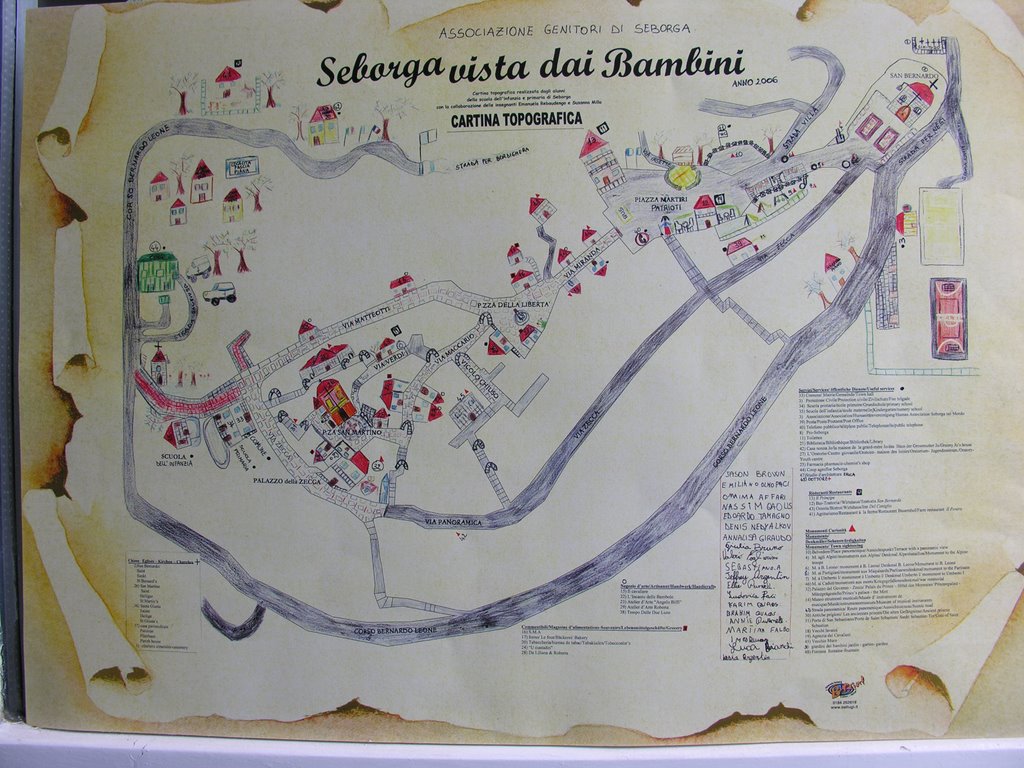
In Piazza della Liberta` (Liberty Square) there is something new to welcome the many tourists arriving to visit the Principality: a large illustrated map of the town seen through the eyes of the children of Seborga!
Yes, the children of the local kindergarten and primary school are the primary authors of the map that is now permanently displayed by Mayoral decree.
Thanks to the helpful advice from architect Tullio Gogole from Vallebona and assistance from their teachers, Emanuela Rebaudengo and Susanna Millo, the young artists have drawn a colourful and well detailed map of Seborga, with street names, places of historic interest, shops and services.
The idea behind this project was to give to the young students the opportunity to learn and better familiarize themselves with the territory in which they live.
Judging by the result, everybody in Seborga is quite impressed, especially those involved in the project.
The illustrated map was unveiled during a ceremony by the Mayor, Franco Fogliarini in the presence of many citizens and the proud young students.
(SeborgaPress)

The Official Program For This Year's Saint Bernard Celebrations

The Municipality of Seborga has released the official program for this year Saint Bernard festivities that will take place on the 20th August. Here is the program:
Saturday 19 August:
19:00 Religious service in the old church of Saint Bernard with procession.
Sunday 20 August:
11:00 Welcome to the authorities;
11:15 Religious service at Saint Martin Church;
12:00 Official opening of the new restored churchyard of Saint Bernard;
12:30 Refreshment offered by Seborga Town Hall;
15:30 Religious procession from the churches of Saint Martin to Saint Bernard;
20:00 Food, wine and entertainment in Piazza Martiri;
21:00 Musical concert by the Principato di Seborga Chamber Orchestra directed by maestro Vitaliano Gallo;
23:00 Historic parade.
(SeborgaPress)

22 July 2006

Celebrating the Summer Season in Seborga

Again this year and following more than 20 years of tradition, Seborga is ready for the summer season with a series of events of all kinds, with something for everyone.
The current events are attracting and entertaining thousands of tourists in its squares and inside the ancient village.
Gastronomic evenings, dance parties, concerts, arts exhibitions and sport events are taking place during all July and August.
In particular, twice a week, every Thursday and Saturday at 20:00 culinary events and entertainment with different orchestras are scheduled.
The local restaurants are busy and the shops are selling souvenirs, coins, stamps, history books, flags and other items of the Principality.
The peak of the summer program of entertainment will be on the 20th August with the celebrations of the national day: Saint Bernard. (SeborgaPress)

The Magic Flute of the Seborga Chamber Orchestra

The Chamber Orchestra Principality of Seborga will celebrate the 250th anniversary of the birth of W.A. Mozart with three performances of the Magic Flute.
The first concert is Monday 24 July, starting at 21:00 at the “Auditorium Comunale” of Ospedaletti. The second concert will be held on the 15 August at 21:00 at the Roman Amphitheatre in Ventimiglia and the final one on the 20 August, at San Martin square in Seborga. (SeborgaPress)

Grand Finale for the International Music Chamber Course 2006

Closing Concert for the participants of the International Music Chamber Course 2006. The program of the International Chamber Music Course 2006 organized by Maestro Vitaliano Gallo of the Chamber Orchestra Principality of Seborga concluded Wednesday 19 July with a closing concert held in Saint Martin square in Seborga. More that 200 students participated in the course that was held at the University Centre of Imperia.
Of all the participants only four finalists had the opportunity to perform in front of the public at the closing concert: Francesco Mule` (actor), Omar Ferrari (percussionist), Vittorio DeFranceschi (clarinet) and Marco Prevosto (piano).
(SeborgaPress)

Seborga In The World Charity Night

Sunday 13 August, the “Seborga Nel Mondo Association” will organize a special dinner to raise money for the “Cuore Moldavo” project (Moldavian Heart).
The dinner, by candle light, will include a menu of typical dishes from the Liguria Region and an entertainment program.
For the event a series of display presentations will illustrate the work done by the association in places like Morocco, Senegal and Moldova.
The entertainment program includes music by the Principality of Seborga Chamber Orchestra, the performance of artists from Senegal and a dance group from Moldova.
The cost of participation is 15.00 Euro per person and the money raised will go to finance a project devoted to the children of the Moldovan city of Mihailovca. Booking is essential by phoning Flavio at: 3288667390. (SeborgaPress)

Second International Literary Competition

The Municipality of Seborga together with the Historical Library of Seborga and the Principality have launched the second edition of the International Literary Competition.
The competition is open for an essay, edited and original, in Italian or in French, regarding research, study, people, buildings, documents, artistic works and Middle Age historical events.
The scripts need to be submitted in typed or print format and send to the Biblioteca Storica di Seborga - 18012 Seborga (IM), not later than the 10th October 2006. A jury will examine all the entries and only three works will be selected as finalists. The works submitted will not be returned but will be kept in the Library and will be available to the public.
The prize ceremony will take place in Seborga on the 11th November, in Saint Martin Square. (SeborgaPress)

15 June 2006

A Bitter Power Struggle For The Throne and New Challenges For The Principality of Seborga

In the past months and particularly in these recent weeks, the autonomy of the Principality of Seborga has been the attention of the Italian media, due to a series of press releases from a self-declared royal who calls herself Princess Yasmine von Hohenstaufen Anjou Plantagenet and who claims to be the rightful heir to the throne of Seborga. Her name started to appear on the Seborga scene once HRH Prince Giorgio I announced early this year his intention to abdicate in the near future. Before then no one in Seborga knew or had heard about her or her family claims.
Given the widespread coverage of the story, the news that Seborga was looking for a new prince must have reached Yasmine’s house. She immediately mobilized her PR machine by setting up pages on the net claiming to be a descendant of the Hohenstaufens, the German royal family that ruled over the Holy Roman Empire in the 13th century.
She activated supporters, issued press releases to the media and proclamations to the Seborga people announcing her new arrival and presence among them and promising a new and reviving future for Seborga and its people.
At the same time she wasted no time in dismissing Prince Giorgio I and anyone who dared to dispute her rights with unflattering announcements.
All this commotion was done by phone, by faxes and emails, without putting a foot on Seborga soil. In fact, no one in Seborga has seen her yet.
Despite many attempts to get her claims recognised, be accepted by the Seborga people and get the support of the Mayor, the Seborgans responded at first with great surprise and curiosity and then with indifference and annoyance.
HRH Prince Giorgio dismissed her claim, voicing doubts over her lineage and asking why the only public trace of her existence was on the jumbled website of an unknown 'foundation'. "Pah! No one's ever even seen her as far as I know. I call her the 'internet princess'," he said.
Earlier this week, the princess’s office issued a press release to the Italian media announcing that the International Court of Justice (IJC) had recognised Seborga as not part of Italy and in view of that recognition she had decided in the end to cede the Principality of Seborga to the Italian Republic.
"She’s not a princess and she cannot give away something she does not own," was the response of Prince Giorgio to this latest news adding that although the recognition by the International Court was made three years ago and not recently, she has also failed to provide up to now the evidence of the existence of such a document.
These recent events have brought back the attention of the media to the issue of the independence of the Principality and have prompted Prince Giorgio to reveal some of his thoughts on this issue.In an interview to the ANSA (the Italian press Agency), Prince Giorgio said that he and his ministers are talking to big insurance groups with a view to creating a health insurance and pension system for the community. "Then we really will be independent," he said. "We have nothing against Italy, it's just that we're not part of it and our administration should reflect that". (SeborgaPress)

01 June 2006

Fake Degrees, Fraudulent Schemes: Scams Exposed. Widespread Damage To Seborga's Reputation

The article titled “A University in Seborga? Not really…” that we published last February not only has raised a significant interest among our readers but has exposed an unbelievable worldwide scam that no one in Seborga could think of or imagine.

There is no doubt that the fame of The Principality has reached every corner of the world, attracting almost every day the curiosity of the media, engaging many supporters and boosting tourism which is good for the local economy. At the same time however this popularity has caught the attention of a few charlatans who have seen in Seborga a golden opportunity to pursue their own interests (and make money) to the detriment of the reputation and credibility of the Principality and its people.

The lack of an official presence of Seborga on the internet has opened up the opportunity for a proliferation of other websites that claim to be “official” (but in reality are not) and the spread of confusion and misleading activities that can only be classified as fraudulent!
While the Italian Police is conducting an investigation, SeborgaPress has also carried out its own research and the results are quite staggering and grim. The scam’s activities range from false pretences to the selling of titles (chivalry, business rank, etc), stamps, passports, coins (all fake of course), to the more alarming selling of accreditations to online universities.

“We have conducted our own investigation with the full support of Seborga’s local authorities” - declares Renzo Colla, the Editor of Seborga Times – “and for this we would like to thank in particular the Mayor of Seborga, Franco Fogliarini and his team of councillors and also the members of the Seborga Crown. We also appreciate the assistance and expertise of Mr George Brown, director of HigherEd Consulting, a private Consulting and Research Company based in Adelaide (Australia), in helping us to unravel the accreditation scam (http://www.higheredconsulting.com.au/). It’s about time we put an end to all this. Enough is enough, and for this reason SeborgaPress has decided to publicly denounce this scandal”.

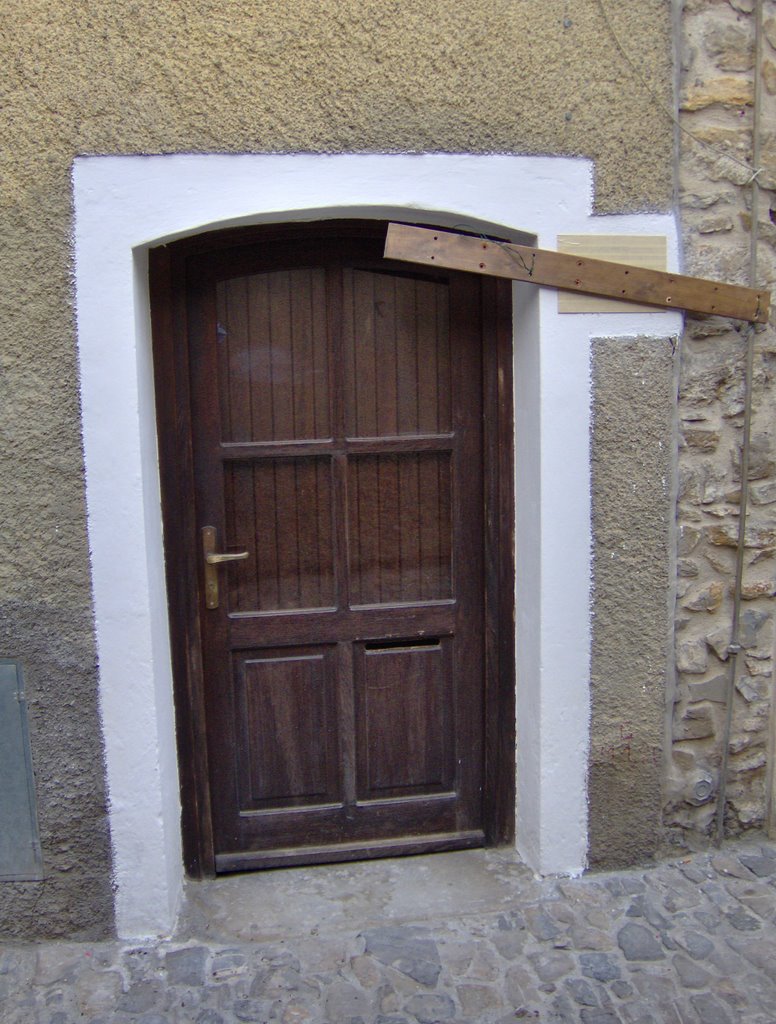
As we have already pointed out in our previous article, there are several online educational institutions and online universities that claim their headquarters or representative office here in Seborga. Well, we have some bad news for those who think that they exist or are being misled to believe it. The reality is that there are no offices or even registered business of that type in Seborga. To help to visualize this reality, we publish the picture of the well known address: Via Miranda, that appears as valid in many contact pages of these institutions. Again, the reality (believe it or not) is that through that door that you see in the picture there is only a storeroom.

In our findings we have discovered that there is a so called “SBC – Antico Principato di Seborga’s Council for Distant Education, Culture and Faith” and “Council of Accreditation” (you can amuse yourself by visiting: http://www.seborga-edu.info/index.htmindex.htmindex.htm).
We won’t go into the tedious details of what this council has made up and claims to be and do, but basically its “mission” is to grant accreditations “to those institutes that “qualify”, in other words that pay for it. Yes, there are fees and you can find out by visiting the Payment Fees page.

This could be a perfectly private business and enterprise and as such we would have nothing against it. The problem is that this “Council of Accreditation” makes use of the name and status of the Principality of Seborga as if this organization (and the people behind it) have received the official right or permission to operate from the Seborgan authorities. Nothing could be more false, dishonest or deceitful than this.

SeborgaPress has found no evidence or proof that either the Seborga Council (from the Mayor downward) or the Seborga Crown (from the Prince downward) or any other local authority have issued to this organization the permission, consent or “beneplacito” to issue accreditations and to work. In fact neither this Council nor any other organisation of that kind exists or operates in Seborga.

As we already mentioned, in Seborga there are only a primary school and a preschool, run by the Italian Department of Education. There are no universities or educational institutions that operate from or in Seborga. This SBC Council is a private business and enterprise set up somewhere by someone and operates under false credentials.

In conducting our research, we realize that this particular type of activity has serious implications and consequences for many people: those who run online universities and courses and have paid “SBC Seborga Council” thinking to obtain a valid accreditation; and those students that have obtained or will obtain degrees that in reality are invalid.

Just to give an example, we read recently on the Daily News - The Voice of Bahrain that a chief physician plans to open an obesity control clinic in Bahrain and that this doctor has been awarded a PhD by Italy’s University of Seborga for his “Marmaki” treatment.

The damage caused to the reputation of Seborga by this accreditation business is already being felt and is becoming widespread. In many education departments and agencies in the world the name Seborga is well known not necessarily for the beauty of the place or for its peculiar history and status.
For them (unfortunately) Seborga is a notorious degree mill that causes headaches and puts international monitoring agencies on red alert. Recently the Inside Higher Ed, an online publication based in Washington D.C., published an article regarding (and questioning about) a new online “university” with associates, bachelors, and master’s degree-granting authority from Seborga (www.insidehighered.com/news/2006/05/24diulus).

The eLerners News Blog, referring to the same article writes: “Many authorities on diploma mills consider Seborga as fertile ground for these unaccredited institutions offering worthless degrees, having been home to now-defunct mills such as Pebble Hills University, James Monroe International University, and Miranda International University, a school connected to the infamous St. Regis University cluster of diploma mills.”

Another scam that the Seborgan authorities are publicly denouncing through our publications is related to the many websites that claim to be the official ones of Seborga. The most notorious, visited by people all over the world, are the ones run by the same person that in June 2001 was appointed by the then Mayor of Seborga (Franco Fogliarini) as “Director of Tourism of Seborga”. His name is Denis Pierre-Francois. At that time he offered his services “free of charge” to promote Seborga’s tourism abroad.

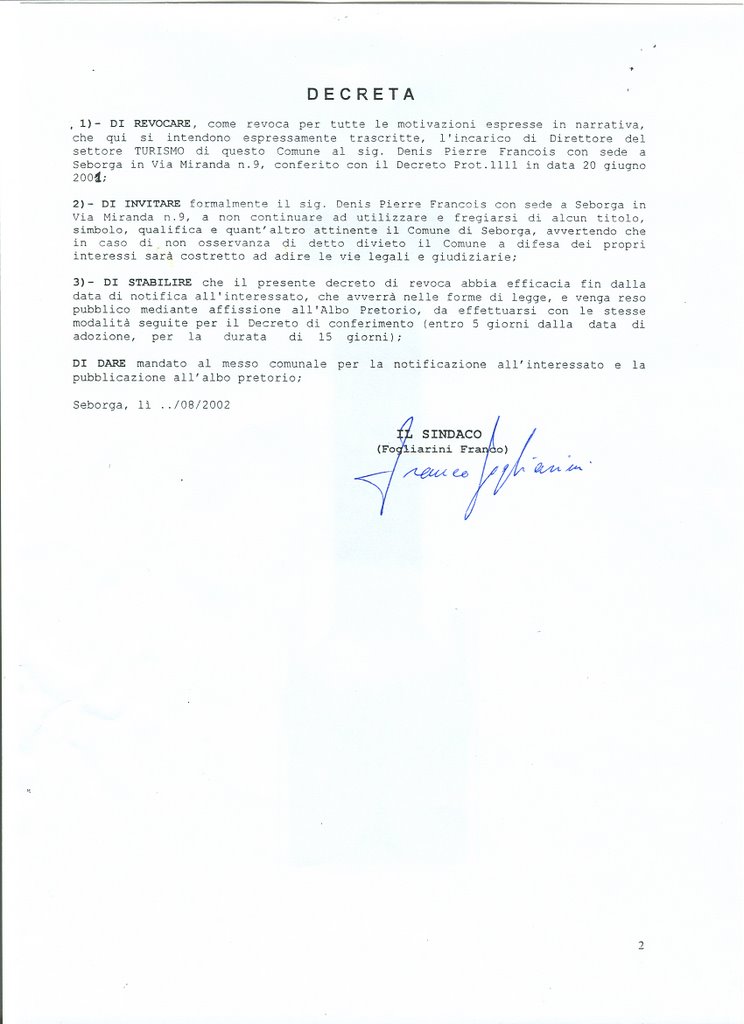
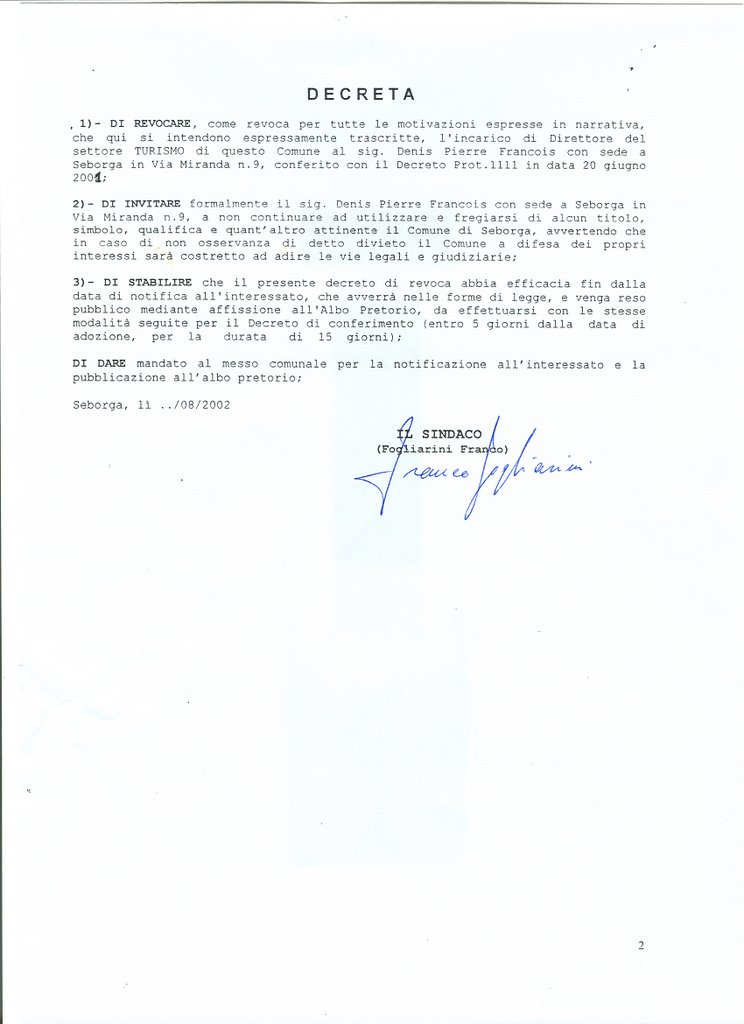
The Mayor and the council accepted his offer but one year later, after taking into account the results (zero) of his post, the Mayor dismissed him from his duty and title with a Decree dated August 2002 (see picture of the Decree).
Not only did the Mayor revoke his appointment of Director of Tourism of Seborga, he also requested Mr Denis Pierre-Francois to cease to make use of or to confer to himself or others any title, symbol, qualification or anything else associated with Seborga.

Do you think this was enough to stop him? Not really. He still maintains in his websites the title of Director of Tourism of Seborga, the title of secretary of foreign affairs, the director of SBC (Seborga Business Centre) and many others. He has established a network of people around the world who after paying the proper fees are bestowed with chivalry titles, business attaché titles, SBS representatives and ambassador’s titles. Not to mention the selling of passports (tourist and diplomatic), stamps, coins, souvenirs (all fakes of course) and last but not least the famous accreditations or licences to online universities. The truth is that at the moment the only way to buy original stamps, coins or souvenirs of the Principality is to personally visit Seborga and buy them from the local shops.

Not happy with that, through his websites he manages to control and filter almost any contact that people outside Seborga try to have with the Principality (this is how he managed to build his network and business) feeding them with false information. Denis Pierre-Francois does not live in Seborga (for obvious reasons) but people abroad are captivated by his manners and presentation and his websites that – although not updated – are quite full of information and photos to see.

The mayor of Seborga, Franco Fogliarini has informed SeborgaPress that the recently re-elected Council has plans to open soon an official Seborga website with the aim to resolve the current situation. We will, of course, inform our readers when this new and official website is operating. In the meantime, anyone who wishes to contact the Municipality is invited to use the official e-mail address, which is: comuneseborga@inwind.it and not to use the ones that appear on other web pages (such as: commune@seborga.net).

SeborgaPress and the Seborgan authorities are taking this opportunity to warn the public to be aware of non official websites, false e-mail addresses and scam activities. (SeborgaPress)

30 May 2006

Seborgans have re-elected Fogliarini as Mayor

Franco Fogliarini (United for Seborga) has being confirmed as Mayor of Seborga at the latest local administrative elections held on 28 and 29 May 2006. He received 131 votes against his opponent: Carlo Bianchieri (New Seborga List) with 83 votes. The newly elected council will comprise of 12 councilors: 8 from the majority list and 4 from the minority list. (SeborgaPress)

03 May 2006

International Courses of Chamber Music

International Courses of Chamber Music from 16 to 19 July 2006: The courses of chamber music are open to qualified musicians and music students of any nationality and instrument and can be attended as an effective student or just as a listener.
The program of the courses (that includes formations for trios, quartet and quintet from the repertoire of the 1700s to 1900s) will be established by the teacher on the basis of the number of enrolments.
Every student will have to prepare and present a piece of music of his choice for solo instrument of ten minutes duration.
Every effective student will - at the end of the course – receive a certificate. The cost is € 200 for effective students and € 100 for listeners. Discounts and special arrangements for accommodation and food will be available in the Principality for those who attend the courses.
For more information and enrolment please write to Mr Vitaliano Gallo at: vitalianogallo@virgilio.it or by phone: 0039.0184.575007 (SeborgaPress)

Seborga on Belgium television

One of our readers in Belgium has informed us that last month the Flemish commercial television channel VTM put on air a short story about the Principality of Seborga during the popular Sunday evening program ROBLAND. You can view the video by visiting the following website:
Many thanks to Jurgen. (SeborgaPress)

14 April 2006

HRH PRINCE GIORGIO WILL DELAY HIS RETIREMENT

HRH Prince Giorgio I made his first official appearance, since announcing his retirement last January, at the celebrations for the Solidarity Without Borders Day, held in Seborga last Sunday, 2 April.
In receiving the nomination of “Messenger of Peace in the World” by the President of the Ligurian branch of UNICEF, the Prince took the opportunity to address his subjects by assuring them that he is still in charge and announcing his intention to delay his retirement.
“I will remain for a few months, until they elect a new prince”, announced the Prince, and continued: “I am tired, and I am looking forward to retiring. But I will not leave the Principality until the Seborgans elect my successor”.
In the crowded San Martino Square, after receiving the nomination, the Prince also spoke strongly against the alleged princess Kathrin Hohenstaufen who – in recent months – with a series of absurd proclaims has declared herself the “heir” of the Principality and even dismissed Prince Giorgio! At first she was invited but later “forgotten” by the organisers of the event. “She is not a princess. It’s all a stunt” thundered the Prince.
The Seborgans welcomed the words of Prince Giorgio and gave the opportunity to Flavio Gorni of the “Seborga nel Mondo Association” to reply on their behalf: “Our only Prince is Giorgio I that has done a lot for us and for our cause”.
(SeborgaPress)

23 March 2006

Seborga will celebrate Solidarity Without Borders Day

The “SEBORGA NEL MONDO – I CARE” Association and UNICEF (The United Nations Children’s Fund) will celebrate the Solidarity Without Borders Day on Sunday 2 April in Seborga with a series of events, from 9:00 AM to 9:00 PM.
The program includes a photo presentation along the streets of Seborga illustrating the history and activities of UNICEF, a video presentation of the humanitarian mission conducted last year in Moldavia by the Seborga nel Mondo – I Care Association and the official awarding of “Messengers of Peace in the World” to all those involved in last year’s charitable mission to Moldavia.
Among the VIP invited are Prince Filiberto of Savoy, Princess and Prince Alduino Ventimiglia Lascaris. Also present at the event will be H.R.H. Prince Giorgio I and the Mayor of Seborga, Franco Fogliarini.

Seborgans called to choose new Mayor

On the 28 May the Seborgans will have to vote and elect the new Mayor. At the moment there are two competing lists for these administrative elections, one lead by the current Mayor Franco Fogliarini and the second lead by his cousin Ermes Fogliarino, currently councillor for the opposition. According to some indiscretions Ermes Fogliarino is said to be more in favour of Prince Giorgio than the current Mayor and given the recent squabble between the Council and the Palace, it will be interesting to see how these two contenders will perform at the coming elections.

Seborga products on display in the "wine town" of Canelli

On Saturday 25 February the Regional Wine Cellar of Canelli (Asti) hosted a delegation from the Principality of Seborga. The aim of the visit was to promote the products and the culinary traditions of Seborga. For the occasion the organizers staged a display of products and food delicacies from the Principality and a special dinner cooked by Seborgan chefs. The city of Canelli, in the province of Asti in Piedmont, is one of the world capitals of quality wines: 580 wines estates are located in the territory of the munincipality and the vineyards cover a surface of 1500 hectares with an average annual production of 10.000.000 bottles. The grape varieties grown are mainly Moscato, Barbera, Dolcetto, Cortese and Chardonnay. The most important wines produced by the wineries of Canelli are Asti spumante (sparkling wine) and Moscato d’Asti (still wine), both wines are obtained from Moscato grapes.

Mambrin patron of the Easter painting competition

Luigi Mambrin will be responsible for organizing the next painting competition that will be held during the Easter holiday in the Principality. As for the previous editions it is expected that the event will be a success and will attract the participation of numerous artists and many people will attend this most anticipated event.

High cost of severe weather

The cost of the damage caused by last December’s heavy snow falls in the Liguria Region amounts of 23 million of euro. The regional authority has estimated and officially notified the amount of the damage to the Italian Department of Agriculture that will now be able to accept and process the claims from the many flowers growers and farmers that suffered from the severe weather. The Principality of Seborga was also affected by heavy snow falls and the Emergency Service had to intervene several times to clear roads and streets from the snow and ice.

Sport: Cycling

Marco Panigata, 65 years old, from Seborga was the winner of the Cycling Italian Championship of Indoor Cycling held recently in the town of Forli. He came first in the amateur category.

***

The first test for the cycling competition of the “Mountain Challenge 2006” from Bordighera to Seborga was won by Marco Bruna for the Junior/Senior Category and by Mauro Monteleone for the Veteran Category. More than 60 competitors took part at this first test that was battered by bad weather.

16 February 2006

A University in Seborga? Not really...

A University in the Ancient Principality di Seborga? Not really, it’s just a rented wine cellar. Various websites in English and also in other foreign languages publicize in fact the presence of a "University" in Seborga: a place where there is not even a high school!
The Italian Police have received a report on this matter and want to find out more about it.
One alarming aspect of this case is one of the places of this imaginary place of learning: Via Miranda 3, Seborga. At this address there is a wine cellar belonging to Osvaldo Romagna, a city council member, who has categorically excluded any presence of a faculty or office whatsoever.
"It’s a very small basement – declares the owner - which I let some time ago to two foreigners, French and – he seemed to me – Uruguayan. They had come to Seborga with the idea of promoting our tourism overseas. It is a fact that, after not having paid the rent for several months, they disappeared from the scene. I don’t know anything about this matter”.
However, the question remains why this address in Seborga appears on the internet as the location of several international organizations that provide courses and degrees on line.
One example is the alleged “Pebble Hills University – SBC Antico Principato di Seborga” that according to its web site is located or has its contact location at the “SBC Building, Via Miranda 3, Suite 303 Seborga.
According to other websites, there are at least thirteen so called “Universities” in Seborga, all accommodated in the same address! There is also a telephone and fax number with an answering machine. According to these websites there are also a bank and a real estate agency in Seborga, all at the same address.
It’s not difficult to find more disturbing examples. If you type in to the Google search engine the words "University" and "Seborga", you may find many other similar sites. On one website, always in English, there are seminars of alternative medicine starting from the 10 of April 2006.
If you follow the indications for registration you can find the related fees to these courses.
If you continue to search you will find that in Seborga there are also the offices of the West Coast University (WCU) “… to serve the students from European and other countries…”
In Piazza dei Martiri, according to others websites, you can find the Hardwood University Seborga or the Keller International University of Seborga that offer courses in design, music and information technology. Now that the Italian Police have been informed of this matter with a detailed report that would indicate acts of fraud via internet, they may soon start an investigation. (SeborgaPress & La Stampa)

24 January 2006

H.R.H. PRINCE GEORGE I HAS ANNOUNCED HIS ABDICATION


H.R.H. Prince George I, at 70 years of age and after 43 years of uninterrupted reign, has announced his abdication. It will be the task of the population of the small Principality to name its successor, by election and conducted in complete autonomy, as it happened in 1963 when the Prince was crowned for life with a plebiscite (from the 362 citizens).
In the sixty days of "vacant post" the eight ministers will continue to govern, together with the 24 Priori that form the Parliament.
The Prince's decision is irrevocable and was announced during a function in occasion of the Festivity of Saint Sebastian (20 January). The official explanation of this decision is because "there is need for renewal and the throne needs of new energy".
But behind the official explanation of this surprising event is a clash with the Mayor of Seborga, Franco Fogliarini, accused by the Prince of “not respecting the history of Seborga”.
The quarrel is in regard to the project of upgrading the area in front the ancient Cistercians Church of Saint Bernardo, a precious monument of 1258, than one legend says has guarded one sacred relic. The planners want to put modern paving around the Church while H.R.H. George I is of the opinion that the area should respect and reflect the architecture and the age of the place when - as the English historians wrote - "Seborga became the first constitutional monarchy of the world ".
"It is my strong wish to defend and preserve our history and our traditions, but, in my capacity as Prince, I cannot start a "war" with the Italian authority represented here by the Mayor", says George I. Some people in Seborga believe that this action from the Prince is just a provocation, an expedient to attract the attention of the public on this matter of grave concern for the Prince.
The question now is if the future successor will be able to continue to maintain the unique characteristics of the place and fulfil the plans of its predecessor. One thing is sure: George I has put Seborga on the world map and raised attention from all over the world. Despite there are being no hotels in Seborga, buses of tourists come everyday to Seborga, from all Europe, keeping all the local restaurants busy.
The origin of Seborga goes back to Centuries. Born as Castrum Sepulcri, Seborga was considered a sacred place for the Catars and still today has maintained a rebellious spirit. Later it become a feud of Conti di Ventimiglia and was consecrated in 1079, as Principality of the Sacred Roman Empire. In 1118 it was transformed in state Cistercians and it remained so until 1729 when it was purchased from Vittorio Amedeo. Many experts and historians from all Europe have been consulted about the validity of the status of the Principality.
H.R.H. George I never tires of repeating and declaring that "the Principato has never been entered as part of the Reign of Italy and – therefore - of the Italian Republic ", and his declaration has the support of many historians and the Catholic Church.
The German historian Wolfgang Schippke wrote in his book "The Mountain Roads of the Ligurian Coast" (Strade di montagna della costa ligure): "Benito Mussolini, in a document dated 1934 recently found in the Berlin archives, declared that "for sure the Principato di Seborga does not belong to Italy" ".
Meanwhile, since 1963 the Principality mints its currency, issuess stamps, number plates for the cars of its residents, guards its borders and maintains regular diplomatic relations with 45 States, including Europe.
The Seborga Times will keep you posted for new developments on the matter.

03 January 2006

Food Trek: fresh porcini mushrooms...

Seborga, a hilltop village closer to Nice than to Genoa on Italy’s Ligurian coast, has attracted tourists since the 1960s by billing itself as Italy’s oldest independent principality. By capitalizing on a paperwork error and declaring himself King Giorgio I, a local flower grower managed to put Seborga and its products on the map. It turns out that Seborga was never officially included on the list of principalities in the 1861 Act of Unification of Italy.
Today tour buses and families head up the hill for a taste of folklore, lunch and shopping. Regardless of its attempts to market itself as an independent state, Italian law prevails in Seborga and the euro is accepted everywhere. We cautiously approach the village, driving around the ancient walls and rounding several hairpin turns along the way. We expect a border crossing and are disappointed when we don't have to show our passports.
“Come in come in, I’ll have a table ready for you at 12:30,” the man gestured towards the back of the restaurant as we stood reading the menu. Seeing that the daily special was fresh porcini mushrooms, we nodded enthusiastically and decided to tour the village before lunch. The sights are easily covered in 45 minutes, but if you stop and talk to the locals you should plan on spending 1 to 2 hours.
Make sure to stop and visit 85 year old Renata Leone in her shop, U Cuntadin, where she sells pestos, marinated peppers, olives and many other preserved vegetables from her garden. The tiny cave-like space is decorated in blue and white, Seborga’s colors, and covered with displays of old garden tools and photos of Renata with her family. My Italian is not so good, but fortunately Renata speaks French having worked in France before the war (World War II). She tells me about the busier tourist season in Summer and Spring and that her family was one of the first to sell products made in Seborga. I leave with some pesto and promise to return soon.
I stop for more food souvenirs at Ruppe Mini Market, also known as Chez Josy, down by the church and stock up on various almond cookies; these pasta alla mandorla are made in Seborga and even the label is handwritten. The official Seborga label on the bag contains information in English about the town and a sticker with the blue and white coat of arms adorns the front, a blue ribbon holds it all together. The packaging in this town is very well coordinated; all the labels in the shops are printed in white and blue and carry the official Seborga coat of arms. I am beginning to suspect that Giorgio (may I call a King by his first name?) actually worked as a marketing executive in a previous life.
Before lunch I had time for one more stop: Il Cavaliere, a shop selling everything related to medieval knights: suits of armor, knives, swords, mace, you name it. Before Seborga became a tourist destination, it was a Principality of the Holy Roman Empire and therefore heavily guarded. In 1079 it became the first cistercian state and it was where in 1118 the first 9 templars were ordained. But, that's really ancient history.
We were having lunch at Il Principe, one of three restaurants in Seborga. The owner, Mr. Ferrari, is known not for cars but for being Seborga’s foreign minister. Like most residents in this village, he speaks fluent French and is a gracious host. We are seated at a table on the covered back terrace where we can touch the fig trees if we reach out far enough. We dine under a portrait of King Giorgio and with a view of the Mediterranean a few miles away. Porcini mushroom tagliatelle and veal with sautéed porcinis satisfy our craving for the local delicacy. The food is simple, not extraordinary, but the setting and the characters in this village are out of this world. Other dining options in Seborga include Hosteria del Coniglio and Taverna Templare, a cheaper eatery on the main square.

If you go:
Il Principe: Piazza Martini Patrioti, 6 Seborga 18012 (IM) Principato di Seborga Tel/Fax: +39 0184 223570.
U Cuntadin: Via Maccario, Seborga 18012 (IM) Principato di Seborga.
(Source: Food Trek http://foodtrek.blogspot.com)

13 December 2005

The return of the Knights of Seborga


It was the year of our Lord 1186 when, in the stronghold of Seborga, the centre of the said priorate, by the decree of Saint Bernard of Chiaravalle (Clairvaux), the povera milizia di Cristo (the poor militia of Christ) came into being, to protect the territories of the priorate, as well as the arrival and departure point for the crusades in the Terrasanta (the Holy Land).
In 1363, after several tragic events for the old militia of Christ, Prince Abbot of Seborga Pons Lance decided to reform the force by founding the “Venerabilis Equester Ordo Principatus Sancti Sepulchri”, from which the knights travelled far and wide through Europe and the Middle East, always as defenders of the priorate (the principality) of Seborga and the Christian faith.
With the arrival of the 19th century the militia was reduced to a few units surviving until the conflict of World War II.
H.R.H. Giorgio I° came to the throne in 1962, by popular consent, and since that time pledged that one day he would re-institute the knights of the “Venerabilis Equester Ordo Principatus Sancti Sepulchri”. The many engagements that followed his mandate forced Prince Giorgio I° to delay the plan until the year 2000 when the first Priorate was formed. From that time until today 6 new Priorates have been established: one in France and five in Italy, but not until recently in Seborga.
Following a meeting one day between the Prince and the knights of the E.N.G.E.A. (Ente Nazionale Guide Equestri Ambientali) a series of developments lead to the opening of a representative office in Seborga of E.N.G.E.A. and subsequently the idea of establishing a Priorate in Seborga.
The proposal was received with great enthusiasm by both parties and it was decided to organize a date to carry out the investiture.
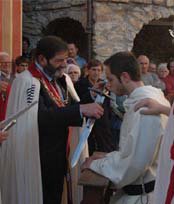
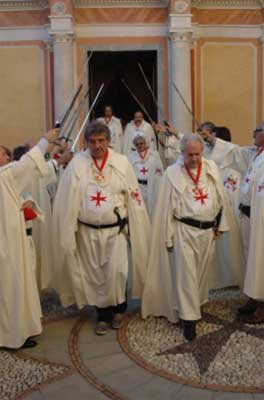
On the 9 October 2005 at 16,30, H.R.H. Giorgio I°, accompanied by the French and Roman prior, received the 10 knights of the E.N.G.E.A. in the old public square of San Martin and in the Church of San Martin.
The knights were dressed in the typical habit (saio) to receive the blessing and then the white mantle with the sword to make an oath of loyalty and reverence towards the Sacred Principality of Seborga. It was a very significant, solemn and moving ceremony.
The knights invested were: Prior Vinati Matteo from Brescia; Vice-Prior Magnetto Attilio from Seborga; Master of Arms Testarella Mauro from San Vero Milis (Or); Sir Peli Leonardo from Brescia; Sir Gianfranco Guerra from Bergamo; Sir Paris Marcello from Rome; Sir Del Vecchio Augusto from Milan; Sir Ivaldi Cesare from Asti; Sir De Michelis Piero Michele from VillaNova Solara (Cn); Sir Musso Lorenzo from Seborga; chaplain of the priory, Don Marco Muraglia.
Soon after the ceremony the knights, the godfathers, the chaplain, the priors and the Great Prior met for the first assembly with a full program of tasks, collaborations, projects and assistance for the needy and humanitarian missions in disadvantaged lands.
These knights of the Principality, through the establishment of the magioni, will carry their creed and faith in all the Regions, Provinces and towns of Italy and in other countries where the E.N.G.E.A. and its associates are present.
Sincere wishes to all and keep up the good work. Adina Pinzi
For more information write to: cavalieriss@sitogea.net or visit: www.sitogea.net

Awarded the winners of the first literary competition

A function was held in Seborga on 11th November to award the winners of the first literary competition held by the Historical Library of Seborga and sponsored by the Seborga Munincipality and by the Principality. Among the public at the event, were present H.R.H. Prince Giorgio I, the Mayor of Seborga Mr Franco Fogliarini and several local authorities. All the winners of the competition received a commemorative inscription and a parchment.
Given the success of the first edition, a similar competition will be held next year and the guidelines of how to participate will be published in this magazine in due time.
Recently a new section was added to the library collections: an historical numismatic section of coins from the Genoa and Savona Mints and several commemorative medallions of particular historical value.

Other news...

The Seborga Ensemble will perform next Thursday, 15th December with a repertoire of Christmas carols and traditional songs as part of a promotional program organized and held by the Vineyard estate Cantina Sociale del Dolcetto di Clavesana.

* * *
Next year on 14th May, a month after the Italian political elections, several munincipalities of the Liguria Region will have to hold elections for the renewal of their local councils; among them the munincipality of Seborga.


To all its readers,
the SeborgaPress
wishes a safe
and peaceful
Christmas
and a happy
and prosperous
New Year!

07 November 2005

FIRST LITERARY COMPETITION OF THE HISTORICAL LIBRARY

This coming Friday, 11 November, starting at 15:00 at the “Sala Polivalente” of Seborga three authors will receive awards in the inaugural Literary Competition organized by the Historical Library of Seborga.
The competition comprised of edited and original scripts in Italian or French regarding Nations, personalities, buildings, documents, artistic features and historical events of any country in the world.
The works were selected and judged by a jury supervised by the Mayor of Seborga: Mr Franco Fogliarini. Here are the titles and names of the winners:

“The influences of the French culture in the Gran Duchy of Tuscany 1737-1790” by V. Massai;

“Sacred articles embroidered and painted at Santa Lucia del Mela” (a locality in Sicily);

“Trails of pilgrimages for the Archangel Michael in Campania, between the middle ages and the modern era” by C. Cerase.

The Historical Library of Seborga was inaugurated on the 23 April 2005 and initiate by Mr Giorgio Pistone.
The Municipality of Seborga donated the premises (a small room) and Mr Pistone donated the entire collection that comprises two thousand books, six hundred magazines and summaries, all of an historical nature.
Since the opening, the Library has been visited by scholars and people of all types and age: from an 11 year old girl of Moroccan origin to a lady of 92 years.
Many researchers come to visit the Library from the nearby towns. In particular, one student is from Oslo (Norway) who is studying the toponymy of the nearby town of Vallebona.
In the library are also kept thousand of photocopies and original documents of the XIV-XX centuries, regarding the Principality of Seborga.
All this material was recovered by Pistone from archives in Ventimiglia, Nice, Turin, the Vatican, Genoa and Vienna, in Germany, in Belgium and in Spain.
Giorgio Pistone has work for 53 years as a land surveyor and technical consultant for tribunals and Courts of Appeal. He has published 29 volumes of subjects related to his profession.
He has also written historical books related to the city of Sanremo and the Principality of Seborga. Lately he has also composed poems and theatrical plays in the local dialect.
The Historical Library of Seborga is open to the public Mondays from 15:30 to 17:30. All are welcome.

05 November 2005

DIARY OF A HUMANITARIAN TRIP TO MOLDOVA

The following is an extract of a translated article published in Italian in the “Gazzetta di Seborga nel Mondo” and written by the newly elected President of the “Seborga Nel Mondo Association”: Elisanna Capocaccia Lippi. We decided to publish it here and shared with you because this article is a vivid account of the many aspects that characterized this mission to Moldavia and a good insight into what the people involved in this project went through. As you will discover, this will not be the last trip to Moldavia. There is a wish – despite the difficulties encountered – to return and do a few things. According to Flavio Gorni from the Protezione Civile of Seborga and Vallebona (the Seborga and Vallebona Emergency Services) there is also a plan for next year to visit two places: one in April to Transnistria and the second one to Paraguay at the end of August. For more information, visit the following website (available only in Italian): http://seborga.blogspot.com

25 August 2005: from a small and picturesque village of the Liguria Riviera, a group of volunteers of the Emergency Services united under the name “Seborga nel Mondo (Seborga in the World, a non profit association) starts a humanitarian journey with the destination Chisinau.
This group is made up of people from regions such as Liguria, Piedmont, Valle d'Aosta, from Rome and my self, from Lombardy. Its 23:00 and the column of cars, vans and a truck start to move from the main public square of the Principality of Seborga crowded with people wanting to meet us and farewell us.

The local authorities are there and the Bishop of Ventimiglia too with his blessing for us. And so we go through the freeway illuminated by the beacons of our lights… via Tortona, Brescia, Verona, and then a short stop and up again towards Udine, Tarvisio, Austria...
More stops on the way for change the drivers have some breakfast with coffee made from home, lunches made of slices of breads with tomato, a little bit of salt and olive oil, all rigorously carried from home.
And up on the road again that leads us to Chisinau, but we must cross Austria, Hungary and Romania first! And while we are travelling we are full of enthusiasm, chatting along and wanting to exchange ideas and expectations about the mission and what may lay ahead for us.
We talk about our lives, the ups and downs, our hopes… we start to get to know each other better and lay the ground for a deep, solid and beautiful friendship that I hope will last forever.
And in the meantime the landscapes are passing by and changing in front of us: from the green and rich slopes of Austria, to the well kept Hungary and everything is going well.
Finally we reach the border of Romania! First signs of something wrong… the stop is long, too long and wearing. We try to occupy ourselves by having something to eat, by making some coffee but we talk less. It is our eyes that speak on our behalf while we look discreetly at our friends frantically dealing with the customs police. All our papers are in order: permits, authorisations, forms from the Red Cross and UNICEF and finally we can pass.
We feel something weighing heavily upon us, we feel apprehensive but at the same time hopeful, but this stop is bothering us. But we are travelling now and crossing Romania with cheerful spirits with songs and laughs to the next border. Here the truck full of humanitarian aid, clothing for men, women and children and other material is stopped. Hours of negotiations, of frantic phone calls, of begging, of waving documents are taking place. Nothing seems to help.
The truck that carries only aid donated by many cheerful hearts from Seborga is halted. It cannot pass. It’s night. We decide to go ahead with the rest of the convoy. We will try to resolve the problem tomorrow. Sadness and helplessness overcomes us and with heavy hearts we approach the Moldavia border. More bureaucracy… endless bureaucracy is awaiting us. They don’t even help us to fill in the visa forms that each of us has to pay from our own pocket.
After a couple of hours we cross the border. We travel the last leg of our journey that will take us to Chisinau: a shabby road, full of holes and dogs corpses crushed by cars.
Dogs that crowds the countryside and the cities of Moldavia, abandoned and stray dogs, ideal for spreading disease! Finally we see the lights of Chisinau, one stop in a trattoria for a frugal dinner and on the move again towards the association that will accommodate us all.
A cold shower (and for the next 6 days) and then everyone goes to sleep in their sleeping bags. No one has the courage to admit it but we have fearful of tomorrow, for what will happen to our truck full of stuff seized at the border. Will we get it back? Will they steal the goods? Will they want money? It’s morning now. Four of us will go to the border, the rest will remain here to get ready for the mission, to do training, to look for wholesalers and buy material that we need.
More problems… Between lies, indirect threats and excuses from those who are supposed to be interpreters and institutions, we become lighter and poorer!! But we begin to raise our heads and start to say “no” or "after" to try to buy time. There is no doubt that we are in a corrupt country but we are not so naive!!!

To cut it short: the truck arrives after paying 910 euro and leaving 10 tons of goods, plus 300 euro for being granted some cold water for the showers and a shelter to sleep in our sleeping bags... They still want more money and goods but “we will bring them in the next trip...” He who deceives is himself deceived!
If you think that – after all - we were lucky, listen to this: we wanted to inspect an orphanage that was reported to us with big problems in Transnistria (a Moldova region self proclaimed independent in 1990 but not recognized by other states).
At the border we were robbed by the customs officers of 200 Euro with the threat that if we did not pay, they would have to put us in jail for two years for transporting suspicious equipment!!!! In order to maintain contact with the convoy at the traffic lights and crossings we were equipped with portable radio transmitters with a maximum capacity of 5 km radius. The same types used by kids to play. After we pay and see some smiling faces in return, we get back our portable radios and are wished a good trip.
However, despite all these depressing episodes, all the rest went well. The population that lives their poverty with dignity is in need of everything. Just a visit to the market and you discover that what they sell in plenty of supply is misery!
Someone sells one of his two eggs or one litre of the one and a half litre of milk to be able to buy some socks for his kid or to buy one loaf of bread. The earth itself is black, empty, untilled and seems to cry of desperation! There are no usual agricultural tools here. To cut the grass they use a scythe hook. Every morning the women take their cows to graze the grass in meadows 3 or 4 km away...
In the cities groups of stray dogs roam in search of crumbs that will never fall from those who have not bread to eat! However, we carried out the entire programs that we planned and regained the time lost. We managed to hand out everything and buy locally to then distribute towels, underwear, stockings, antiseptics, detergents, rice, pasta, flour, tins of tuna and meat.
Nothing special for such poverty but the smiles, the poetry recited for us, the eyes
full of appreciation made us feel "great"! And this thanks to all of those that have helped us… You are the providers of this beautiful gesture that we have only carried out.
We came home with beautiful memories; beautiful evenings spent together among the local people (all documented by our famous photographer and photo reporter, both volunteers). I hope that they will make a photo album and a CD to sell and finance other projects.
We have plans to renovate an orphanage and build proper bathrooms for another orphanage; therefore we need the help of everybody! Even the 50 cents from a child that renounces his snack could help!
This precious money will go to a less fortunate child that with his little nose resting on a dirty and broken window frame is dreaming of a cuddle, a friendly hand, a pair of socks in order to protect himself from the cold! We can all make a difference for these and other less fortunate ones!

To those who are planning to visit the Liguria Region, I would like to say this: come to visit the Principality of Seborga. You will get to know and meet GEORGE I, a charismatic and altruistic person, beyond every expectation. You may also have the chance to see his knights in their white uniforms. Come and have lunch or dinner in one of the three restaurants of the Principality. Buy some Luigini (the local currency) and some stamps.
And when summer comes, take part in the parties and festivals held in the public square of Seborga. The local Pro-loco association will direct 10% of the revenue to us from these events. You will do well and at the same time have fun between a tango and a waltz!
To conclude I must thank all the Seborgans, from the first (Prince Giorgio I) to the last. Thank you for all the volunteers that also gave me the honour of electing me as their president and have given me the nick name of “mamma”.
Thank you to the people of Seborga who have accepted me like one of them. I want to thank you Graziella who, like a sister, has made her house available to me.
A big hug from my heart and with God’s help, for any need, I will be among you and won’t disappoint you. Thank you for those that have helped us and will help us again. Together we will make progress.
Elisanna Capocaccia Lippi
(President of Seborga nel Mondo Association)
OTHER NEWS...

Seborga is one of thirteen of the sixteen councils belonging to the Intermelia Mountain Community that has joined together for recycling and waste management. The contract for the work has been assigned to Aimeri Ambiente sr Ltd, a company from Legnano (Milan) and will provide the service for the next five years.

14 October 2005

South African Club Lunceon, October 23
The South African Club of the Cote d'Azur is having a luncheon on Sunday October 23rd in the fabled "Principality of Seborga". The host will be local personality Mark Dezzani, a long time resident of Seborga. Mark will be giving commentary, background and the history of the Principality during pre-lunch drinks. Nothing fancy or formal: just casual and good fun. The all inclusive Italian menu including wine and coffee is €17 per person with a reduced menu and price for children at €10. You don't have to be South African to attend, everyone is invited. To reserve telephone Hugh at 04 93 86 04 77 Portable: 06 75 93 90 93 or email: hughmitford@wanadoo.fr

04 October 2005

AIDA REOPENS THE ROMAN THEATRE

With the Aida of Giuseppe Verdi, played by the Chamber Orchestra of the Principality of Seborga, the Roman Theatre of Albintimilium, the ancient name of the city of Ventimiglia, reopened to the public for the first time after almost two thousand years of closure. The event, sponsored by the Italian Ministry for the Arts and Cultural Heritage and organized by the cultural associations of Endas and Porta Marina and by the Institute of Research Angelico Aprosio, had the proper title of: “After 2000 years of silence”.
The orchestra conducted by the maestro Vitaliano Gallo, played music from the famous Verdi Opera Aida and from the sound track movies The Gladiator and Star Wars. The proceeds of the evening went to charity.
Giampiero Martino, President of the Archaeological Park of Nervia, said: “It is with great pleasure that the city of Ventimiglia is symbolically reclaiming its history by using again this theatre that our ancestors have wanted. This is an experiment and the theatre has still serious acoustic problems to resolve caused by its proximity to the Aurelia road and the railway lines. But we are positive about resolving these problems by using sound insulation barriers”.

The next commitment for the orchestra is for the 29 October at Imperia-Oneglia University, with a concert starting at 20:30. Music by Boccherini for the 200° anniversary of his death and for the exhibition organized by IBIS (the Italian Buddhist Institute) titled: "i semi del cambiamento" (the seeds of change).
For more information, visit: www.orchestraprincipatodiseborga.com

The construction of the theatre is dated around 180 A.C. Located on the western border of Liguria, Ventimiglia has had a complex history. It begins with the ancient Roman settlement of Albintimilium, the largest town in this part of the province. Considerable Roman remains are visible near the mouth of the Nervia River, while the mediaeval town is perched on a rocky spur to the west. The modern city did not develop until the late 19th century around the railway station. The territory of Ventimiglia offers very fine landscaping and real estate has developed in the zones of Latte and Mortola. The peerless climate and the fertility of the soil were ideal for establishing fine gardens, subsequently renovated in the late 19th century, the most remarkable being the Hanbury Garden.

PROJECT MOLDAVIA ACCOMPLISHED

The entire Principality of Seborga and its people led by H.R.H. Prince Giorgio I, was behind the organisation of a humanitarian project called “Progetto Moldavia 2005” that draws the participation of many associations and groups from many places in Italy and from the Republic of San Marino.
For the preparation of this humanitarian mission the Principality hosted and organized many public events for raising funds and materials needed for the project that started on 26th August and ended the 10th of September.
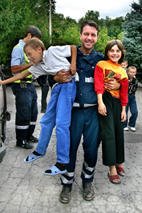
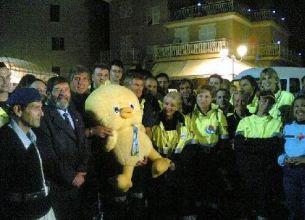
The group working on this project was formed by volunteers of the Italian, Seborga and Vallebona Emergency Services, members of the “Seborga nel Mondo” association and Red Cross of Bordighera, doctors, registered nurses, veterinarians, first aids trainers, members of the Italian police and interpreters, all under the patronage of UNICEF International and the Liguria Region.

The primary aim of this mission was to provide training in the areas of health (first aid courses, hygiene, child welfare, rehabilitation and physiotherapy) with the purpose of raising the level of autonomy of the local population. The project also was intended to provide the distribution of clothing, curriculum material, agricultural tools and buying local food and pharmaceutical products to promote the local economy.
The team lead by Flavio Gorni comprised of five vans and more than 20 people and left Seborga just before midnight on the 26th August in the presence of many people who wanted to witness this important event. The team was saluted by H.R.H. Prince Giorgio I, the Mayor of Seborga Franco Fogliarini, and Monsignor Alberto Maria Careggio, bishop of the diocese of Ventimiglia and Sanremo.
The mission was accomplished successfully and there is now the feeling and the desire among the organizers and the volunteers that this mission will not be the last.

The Republic of Moldova is a small country, situated in the Southeast part of Europe, neighbouring Romania to the West and Ukraine to the East. This piece of land boasts a rich history, abundant in dramatic event
s and turmoil.
From the XIV century it was a part of the Moldova Principality, situated between Oriental Carpathians and the Nistru River, in the north bounded by Hotin, and in the South – by the Low Danube and the Black Sea. Following the Peace concluded in Bucharest, in 1812, a part of this territory was assigned to Czarist Russia, which called it Basarabia - an older name, earlier attributed to the southern part. The aim was to identify this territory as a separate geographic entity from the Moldova Principality.
The Independence of the Democratic Republic of Moldova was proclaimed in January 1918. And later, on March 27, 1918 it was decided to re-unite it with Romania. The next annexure process took place in 1940, following the Molotov - Ribbentrop summit.

According to this, Basarabia became part of the USSR and was proclaimed as the Soviet Socialist Republic of Moldavia. It comprised only nine Basarabian counties and six districts from the left bank of the Nistru River. The present territory of Moldova is smaller compared to the area attributed to Russian authorities in 1812, since the North Hotin, Acherman and the southern Ismail were given up in 1940 by the Soviet authorities to Ukraine.
Due to the restructuring process that started in Central and Eastern Europe, in June 1990 Moldova proclaimed its sovereignty, and on August 27, 1991, its State Independence. On March 2, 1992, the Republic of Moldova became a member of the United Nations.

NEWS IN BRIEF...

H.R.H. Prince Giorgio I and His Knights launched in August an artistic auction to cover the costs of restoring the church of San Martin in Seborga. The collection on sale comprised 24 artistic paintings from artists who donated their works for this event and was exhibited at the Park palace of Bordighera.

A Mayor from the Italian Republic and a Knight from the Principality of Seborga were the celebrants of a wedding that took place at the Town Hall of Sassello (Savona). The vice Mayor Michele Ferrando was assisted by the former Mayor of Sassello Paolo Badano wearing the bicolour sash of the Knight of St Bernard of the Principality of Seborga. The couple: Tina and Fahrchid (Iranian and German origin), chose the town of Sassello as a place to holiday and to get married 10 years ago. The couple specifically wanted to be married by the then Mayor Badano who retired from public duty last year.


03 October 2005

THANK YOU!

Thank you all for the many positive comments and feedback that we have received about our first edition of The Seborga Times. We hope that you may continue to find this publication useful for keeping in touch with the life of our Principality and its people. We have received requests to publish this magazine in languages other than English. We respond to these requests by announcing that from this month The Seborga Times can be read also in Italian. By clicking on “Italian Version” you will be linked to the “Gazzetta di Seborga” which contains the same articles published here. Thank you again for your support and keep writing to us for your feedback or comments that you may have. (The Seborga Times)