31 March 2007

Officially Opened: The New Honorary Consulate in Castellarano

The official opening of the new premises of the Honorary Consulate of the Principality of Seborga was held last Friday 30 March at Castellarano, a city near Reggio Emilia (Italy). The event included several speeches and visual presentations on the history and the distinctive status of Seborga.
Mr Paolo Iotti (Honorary Consul) spoke about the topic "Seborga: a place, a reality and a model". Other topics were on the history of the chevaliers (by the vice Consul) and on future projects and initiatives sponsored by the Consulate. A refreshment concluded the event. More details on the April issue.

Vallecrosia: Conference on the International Cooperation


On march 10 in the city of Vallecrosia, the Seborga in the World Association held a conference on international cooperation. The aim was to present and promote the cooperation not just as an existential concept but rather as a way to promote and develop the Global Village and offer reciprocal benefits between two states, in particular Italy and Moldova.

The ability to educate a child or student about solidarity is a very important step for the development od a society. The conference was also an opportunity for the Association to share with the public the experience of past missions to Moldova, the poorest country in Eastern Europe.

During the event the project "Un Ponte Sul Cuore" (A Bridge Heart) was also presented, an initiative that will involve students from different schools in Italy, Seborga and Moldova. The students will participate in a theme competition that will end in May with a special ceremony at the theatre Casino of Sanremo.

At the conference were also distributed drawings from students in Moldova to the students of the St Anne Institute in Vallecrosia. A video presentation was also shown of the recent trip in December (2006) where two tonnes of toys were distributed to the children of Moldova, toghether with teaching material and other items for the schools overe there.

The event ended with a display of photos by the famous photo reporter GB Peluffo that took part in August 2005 at one of the missions.

26 February 2007

From the Mint of Berlin a Medal to Sponsor the Project of a Museum of Modern Art in Seborga


A commemorative silver medal was officially displayed on Thursday 15 February to the Mayor of Seborga by the German artist Heiko Sachse. The medal was specifically produced by the mint of Berlin to celebrate the future opening of a museum of contemporary art in Seborga.
The revenue from the selling of the medal, which will be sold in 999 specimens, will be used to finance the museum.
This is the second initiative taken by the Berlin artist who has already put to auction some of his artistic works for this particular project. Last autumn the City Council of Seborga officially presented the project of the museum in collaboration with two German companies (which will cover the cost) and offered to provide the land to build the museum.
Although originated in Germany, the project is part of a series of initiatives for the cultural and tourist development of Seborga and has the full support of the local authority.
Heiko Sachse is the author of several artworks regarding the royal family; many of them are exhibited at Buckingham Palace, St James Palace and Westminster Abbey.
(Photo: Franco Fogliarini, Mayor of Seborga and the artist Heiko Sachse. A note from the Editor: in an early edition of the same article we inadvertently published a wrong picture of the artist. We apologise for the error and for any inconvenience caused)

Cycling: First Test for the "Mountain Challenge 2007", Bordighera - Seborga


The first test for the traditional annual cycling competition of the “Mountain Challenge 2007” from Bordighera to Seborga was won by Dell’Oriente for the Junior/Senior Category (1h 22’) and by Ginestra Flavio for the Veteran Category.
Like last year, the sixty competitors took part in the first of eight tests of the competition in bad weather, cycling through the Nervia valley, from Dolceacqua to Ospedaletti, Bordighera and finally to Seborga after tackling the never ending uphill road of 11 km. The next test is planned for Sunday 4 March, starting at Bordighera for the “Romana” circuit.

31 January 2007

Sanremo: Corso Fiorito 2007

From Jan 14 to Feb 04 the city of Sanremo hosts the “Sanremo in Fiore”, flower festival with the charm of the “Corso Fiorito”, the impressive parade of procession of floral floats. This is an annual event where all aspects of flora produced in the Ligurian Ponente (western Liguria) are exhibited, from evergreen plants, cacti, flowering plants to aromatic herbs.
It is an event not to be missed where one can immerse oneself in the thousands of colors and perfumes only to be found in the Sanremo area, thanks to its microclimate allowing them to be cultivated in winter.
“Corso Fiorito” is also an opportunity for the many flower growers in the area to compete against each other under a common theme (chosen by the organisers) with their best floral composition.
This year’s theme was the cartoon characters and for the challenge twelve towns and villages participated in the event that culminated with the floral parade last Sunday, 28 January.
This year winner, for the second consecutive year, was the town of Santo Stefano al Mare with the floral composition representing the “Pimpa” character (photo on top). Seborga participated with a floral float representing Diabolik character (photos on left).

The first edition of "Corso Fiorito" was held on January 1904 and was called "Festa della dea Flora" (Feast of Goddess Flora). There were "floral" carriages on which the "pioneers of flowers" showed their novelties. This event was so successful that it was held year after year and it also gave rise to the "Battle of Flowers" in which several floats were entirely covered with flowers. After the war, the parade was called "Italia in fiore" (Italy in bloom) and was accompanied by bands and folklore groups. Thanks to this parade, Sanremo thus became the Town of Flowers par excellence. Nowadays the “Corso Fiorito” is one the most important events in Sanremo and certainly the most eagerly awaited.
The preliminary phases last for several months, and then everything happens in one single night: from sunset to dawn the floats blossom thanks to the skill of the people who decorate them. Thousands of colourful flowers create marvellous compositions: faces, dresses, animals, clouds, stars and setting are all made up of flowers.
When the moon gives way to the break of day, the floats are ready. The feast can start. And the town streets are thus full of life - also thanks to the bands that accompany the parade every year.

New Premises for the Honorary Consulate in Castellarano (Italy)


The new premises of the Honorary Consulate of the Principality of Seborga in the Italian town of Castellarano (Reggio Emilia) will soon be officially opened.
Although there is not a final date yet, the opening will take place some time in February with a conference followed by refreshments.
The announcement came from Mr. Paolo Iotti, Honorary Consul who said that the new premises were provided by the city council as result of a specific agreement between the Principality of Seborga and the city.
The Honorary Consulate was instituted by decree by HRH Prince Giorgio Ist on 28 November 2001. The Consulate will host conferences and seminars of a historical, musical and artistic nature.
The new premises are located in Via Kennedy, 27 and the Consulate has activated a web site that can be visited at this address: www.beepworld.it/members/consolatoonorariodiseborga

Emergency Birth

On Friday 12 January, a woman resident in Seborga gave birth under emergency circumstances. When the labour started the woman realised that she could not reach the nearest hospital (20 km from Seborga) and an ambulance was sent to assist her in giving birth to a baby boy.
Since the Italian authorities decided to transfer the obstetrician department in the town of Sanremo, many children in the area have being born at home or in an ambulance. Mother and child are well.

23 December 2006

10 December 2006

Father Christmas In Moldova With The Seborga In The World Association

The Seborga in the World Association is planning a trip from 28 December to 4 January to Moldova. The plan is to distribute toys, clothing and other items to the many children of poor families in the town of Mihailovca and in the south of the country.
For this project many students from different school grades in the province of Imperia are involved in collecting the goods for these less fortunate.
This initiative has received support from the Italian Red Cross, UNICEF and the Moldova Embassy in Rome.
During this trip the volunteers of the association are also hoping to successfully transfer from Moldova to a hospital in Rome an 11 year old girl who is currently suffering from cerebral paralysis. This girl has not seen her mother (the only relative left) for the last two years since she started to work in Italy to cover the medical expenses.
The girl is presently in an orphanage and the organisers are hoping to have all the papers required by the bureaucracy to be able to transfer the girl to a hospital in Rome for proper treatment and to allow the mother to see her daughter again. If they succeed it will be a very special Christmas present for this small family.

The Tree Fete Is Back Again In Seborga And In The All Intemelia Community


The Intemelia Mountain Community together with the Italian Forestry Corps has recently re-established “The tree fete”: an old tradition well practised in the past in the region.
The aim of this initiative is the planting of 500 trees among the municipalities of the mountain community and for this purpose the organisers have requested the involvement of the students from various schools in the region.
The opening ceremony was held in Seborga where thirty elms were planted by the students of the primary school under the supervision of the Italian Forestry Corps.
After Seborga will be the time for the other villages with the planting of oaks, olives trees, pines and elms.

08 November 2006

HRH PRINCE GIORGIO Ist OF SEBORGA WILL NOT ABDICATE

It is official: HRH Prince Giorgio Ist will not abdicate!
The spokesperson for the Principality, Mr G. Pistone, has announced that the Prince has decided to remain in charge. “Given the insistence of his most faithful friends and of the entire population of Seborga – declared the spokesperson – HRH Prince Giorgio Ist has accepted to renounce his earlier decision to retire”.


When in January the Prince announced his intention to abdicate – a decision justified by his age (70 years old) rather than the quarrel with the mayor for the upgrading of the area in front the ancient Cistercians Church of Saint Bernardo as reported by some media - the news left everybody in Seborga numb and surprised and reached every corner of the world.
Radio, television and newspapers around the world reported the announcement with great prominence and many journalists from important newspapers and magazines came to Seborga to investigate the case.
Now, we welcome the news of His change of mind with great relief and happiness because it will certainly bring an order and stability which recent events and characters have threatened of late, upsetting the tranquillity of the place and the honesty of the Seborgans.
This episode, beside the glamour created, has demonstrated that the cause carried out during many years by the Prince Giorgio Ist for the recognition of the independence of Seborga, has gained support and attention never reached before.
The case of Seborga is not as some would have us believe merely a Soap Opera. Today, the case of Seborga is a reality that cannot be ignored and the international community is more aware and sympathetic.
Prince Giorgio Ist is loved by his subjects and admired more and more by people around the world that follow the events happening in this tiny Principality with a passion.
We are happy that Giorgio Ist has decided to keep holding the reins.
There is still lot to do before its time to dismount.
May God grant Him the strength, wisdom and the fighting spirit to continue. (R. C.)

21 October 2006

A Museum Of Modern Art In Seborga


The Municipality of Seborga has officially unveiled an ambitious proposal for the city and the Principality: the creation - with the collaboration of two German companies and an artist from Berlin - of a museum of modern art.
The Mayor of Seborga, Franco Fogliarini has declared that the two companies involved have already promised the funding for the project. The proposal is now going to be assessed for its feasibility but the Council is favourable to publicise the project and to make available the land for the construction of the museum.
The project is part of a series of initiatives for the cultural and tourist development of the Principality. The idea of a Museum in Seborga started from Germany. Heiko Sachse, a versatile artist from Berlin, long involved in the enhancement of the ancient noble traditions of Seborga, has declared that he will auction very soon (the date is yet to be decided) his painting of the rock star Madonna (see photo) in the Principality of Monte Carlo. The starting price for the auction will be 30 thousand euro and the sum collected will be devolved for the construction of the museum.
Heiko Sachse, an honorary citizen of Seborga, recently organized a special event for the 80th birthday of Queen Elisabeth II in Berlin. The event, titled: "The Royal Laser Symphony-Queen Elisabeth" involved a symphonic musical performance written by the artist and a spectacular laser show. Heiko Sachse is the author of several artworks regarding the royal family; many of them are exhibited at Buckingham Palace, St James Palace and Westminster Abbey.
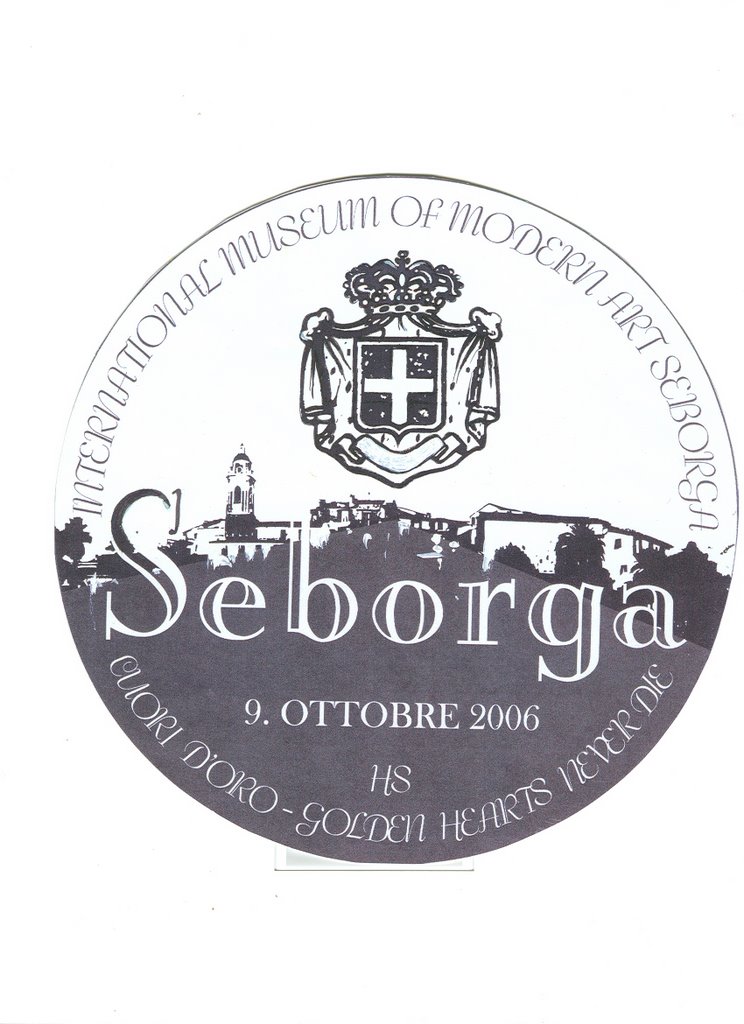
The Municipality of Seborga has expressed gratitude and appreciation to the artist for his commitment in favour of the development of the Principality. The Counsel General of the Federal Republic of Germany in Milan has also expressed appreciation for the project of the museum that will be named: CUORI D'ORO (Golden Hearts).

06 October 2006

The History of Seborga in Piazza


For five weeks, every Wednesday evening starting at 21:00 in Piazza Saint Martin, the curator of the Seborga Historical Library and writer Sergio Pistone will hold a series of lectures about the history of the Principality of Seborga and how it evolved.
The topic of the first meeting (which took place last Wednesday) was on "the ancient people of the territory"; the next topic will be on "Christianity and the heretical doctrines". The meetings are open to the public and everybody is welcome to attend. (SeborgaPress)

23 September 2006

Principality of Seborga: An Historical Synthesis

In the remote prehistoric period the territory of the Ligurian Piedmont is populated by the Cro-Magnon man; in the Neolithic period, around 5000 years ago, an inhabitant of the place that today is called Seborga carves an idol of stone, while others chip away small stones to make some tools. In that period man has spread also to the islands, from the Balearics to Malta to the Peloponnesus and in all the Mediterranean.
For a millions of years man inhabits this area, this Ligurian Provenza, gifted with a fortunate climate that has allowed him to prevail over glacial periods. A Ligurian population, always settled in our mountains, made of rough, strong and patient men who, incredibly, love these stones, this barren and poor land.
Towards the end of the Bronze Age, 1250 - 1300 B.C., one small tribe, belonging to the Celtic world and coming from the Euro-Asian east, crosses the barrier of the Maritime Alps, comes down along the divide that from the Marguareis mountain descends to the sea at Bordighera and occupies the west side of the mountain.

In the mountains, and always on the western side, some important people are buried in large tombs. Among them, one burial ground gives this place the name of Seborga. The occupied territory, divided into four villages (today Castelvittorio, Baiardo, Perinaldo and Seborga) is governed by eight men, two from each village, who then elect a leader.

The eight faithful and their descendants settle in these places and near the main tomb: they guard it, they defend it and they make it a reason for living for thousands of years and more.
This tradition, of eight plus one, will continue for thousands of years to come, until the time of the establishment of the rules of the “Paupera Militia Christi” of Saint Bernard and the Order from which its name originates.

With some difficulties, the descendants of the original tribe become part of the Ligurian population and, in part, they adopt the local language and customs, maintaining at the same time their own. One of the words that they accept, typical of the Palaeolithic-Mediterranean language, is the name that is given to the place: Sepulcrum. This name will give the village a prerogative and a sacred role, never to be lost or forgotten.
The ancestors of present day Seborgans do not get involved in the Romano-Ligurian wars, indifferent to the object of the dispute: officially the creation of a coastal road that links Rome with Marseilles, but in practice the subjugation of the Ligurian people to Rome.

At the time of Jesus Christ and the early Christian church, Seborga, with all probability, is directly interested in the absurd issue of the siblings of Jesus. The particular affection that the Jews have for the Ligurian Provenza zone is clearly documented; the Romans themselves confirm this line of contact by exiling to the Rodano valley and the surrounding area the Jews who resist and revolt against Roman domination. With the crucifixion of Christ, begins the Diaspora of Christians to different parts of the world and, of course, in our mountains, where they meet the descendants of the Celtic tribes.

The two religions have great and fundamental points in common, among them the oneness of God; the immortality of the soul; an intermediate world in which, after the death of the body, the soul is weighed; respect for the saints; the refusal of the sacred representations (the iconoclasm); brotherly love for all; tolerance towards other religious beliefs; and also a particular preference for the sacral meaning of the numbers three and eight.

At this point a mechanism is released, still not clearly understood in its essence but surely linked to the name of the place. The village becomes the “SEPOLCRO” (Sepulchre) for a relic of such importance and sacredness that it cannot be named. From this moment forward, for two thousand years, the place of Seborga becomes sacred: no armies conquer it; no States aspire to it; no Monarchs claim it; and no one even wants to mention it!

With the passing of the centuries this distinctiveness remains unbroken and the reputation of Seborga, always coexisting with the secrecy of its location, is widely known in the Christian world but - it should be said - only at higher levels. The particular relationship between the village and the eastern Provenza continues and we see a period characterised by invasions, destruction and pillage; Seborga is always protected, nobody touches it.

The involvement of Ludovico the Pious and the formal creation of the Imperial Principality, with the nomination of the bishop Claudius as first Prince, will allow, through the documents and the parchments that survive to us, the writing of a well documented and authenticated history.

The events that follow “the gift” of Guidone confirm its authenticity, in spite of some difficulties in the interpretation of the document. The religious status of Seborga, even if apparently heretical (think of Saint Cassiano and Saint Bernard), is reaffirmed by the arrival of the Catar refugees.

Time moves on and we reach the second half of the 17th Century, with the minting of the coins of the Principality and the incredible story of the “selling” of the Principality by the Savoia Family. Even then the European turmoils do not touch the ancient Principality, which proves to be alien to the earthly disputes and always rightly ignored for its essentially religious status.

And now, in order to finish, the invention of the Reign of Italy, the fall of the monarchy, the short interval of uncertainty and, in 1963, the election of the Prince, H.R.H. George I, reconfirmed (together with the adoption of the General Statutes) 23 of April 1995.

Thus this short summary comes to an end, although some of the mysteries mentioned in this account remain to be explained: what happened to the Seborga documents taken by Genoa; the exact nature of the sacred relic buried, who knows where, in the Principality.

A rich place of ethereal sensations, of indefinite emanations, of that wonderful feeling that makes those who come with a pure mind and honest intentions exclaim: “I have arrived. It’s here that I want to live; this is my world”. A meeting between the greatest: the Empire; and the smallest: the Principality; this incredible place never blemished by wars, conquests, persecutions, earthquakes, armies or conquerors.

All this, and much more than this, is the Principality of Seborga. Respect her; she deserves it; it is her right.
(Translated from “Principato di Seborga: Sintesi Storica di Giorgio Pistone” by R. & E. Colla - September 2006)

10 August 2006

Seborga Seen Through The Eyes Of Its Young Ones

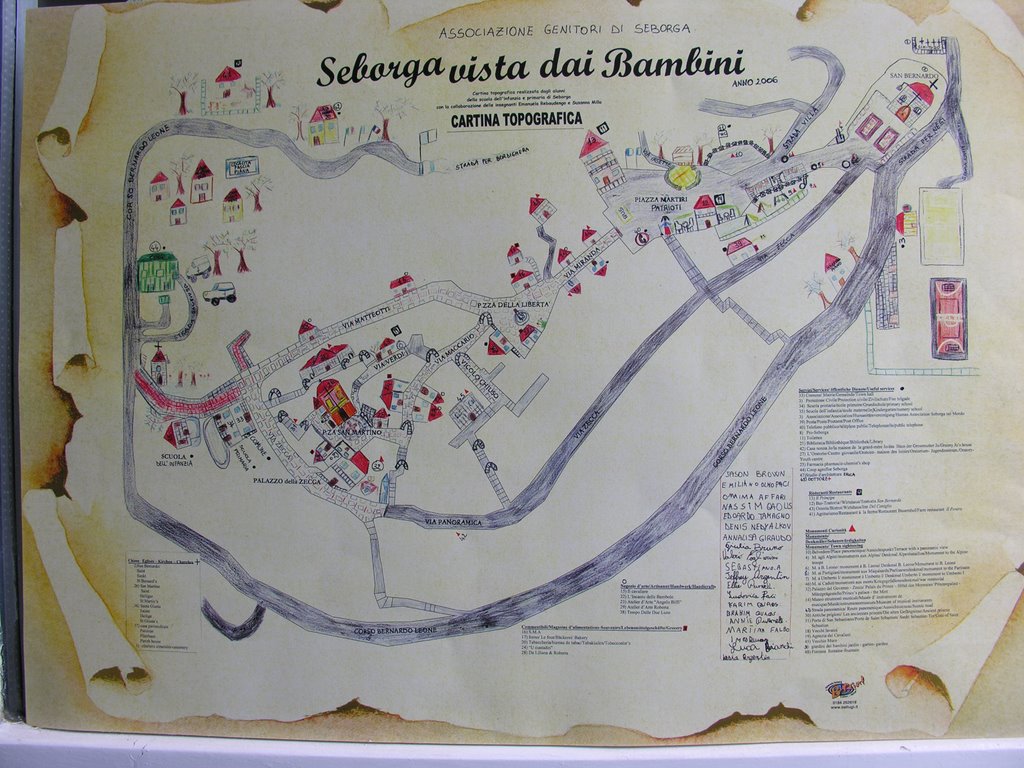
In Piazza della Liberta` (Liberty Square) there is something new to welcome the many tourists arriving to visit the Principality: a large illustrated map of the town seen through the eyes of the children of Seborga!
Yes, the children of the local kindergarten and primary school are the primary authors of the map that is now permanently displayed by Mayoral decree.
Thanks to the helpful advice from architect Tullio Gogole from Vallebona and assistance from their teachers, Emanuela Rebaudengo and Susanna Millo, the young artists have drawn a colourful and well detailed map of Seborga, with street names, places of historic interest, shops and services.
The idea behind this project was to give to the young students the opportunity to learn and better familiarize themselves with the territory in which they live.
Judging by the result, everybody in Seborga is quite impressed, especially those involved in the project.
The illustrated map was unveiled during a ceremony by the Mayor, Franco Fogliarini in the presence of many citizens and the proud young students.
(SeborgaPress)

The Official Program For This Year's Saint Bernard Celebrations

The Municipality of Seborga has released the official program for this year Saint Bernard festivities that will take place on the 20th August. Here is the program:
Saturday 19 August:
19:00 Religious service in the old church of Saint Bernard with procession.
Sunday 20 August:
11:00 Welcome to the authorities;
11:15 Religious service at Saint Martin Church;
12:00 Official opening of the new restored churchyard of Saint Bernard;
12:30 Refreshment offered by Seborga Town Hall;
15:30 Religious procession from the churches of Saint Martin to Saint Bernard;
20:00 Food, wine and entertainment in Piazza Martiri;
21:00 Musical concert by the Principato di Seborga Chamber Orchestra directed by maestro Vitaliano Gallo;
23:00 Historic parade.
(SeborgaPress)

22 July 2006

Celebrating the Summer Season in Seborga

Again this year and following more than 20 years of tradition, Seborga is ready for the summer season with a series of events of all kinds, with something for everyone.
The current events are attracting and entertaining thousands of tourists in its squares and inside the ancient village.
Gastronomic evenings, dance parties, concerts, arts exhibitions and sport events are taking place during all July and August.
In particular, twice a week, every Thursday and Saturday at 20:00 culinary events and entertainment with different orchestras are scheduled.
The local restaurants are busy and the shops are selling souvenirs, coins, stamps, history books, flags and other items of the Principality.
The peak of the summer program of entertainment will be on the 20th August with the celebrations of the national day: Saint Bernard. (SeborgaPress)

The Magic Flute of the Seborga Chamber Orchestra

The Chamber Orchestra Principality of Seborga will celebrate the 250th anniversary of the birth of W.A. Mozart with three performances of the Magic Flute.
The first concert is Monday 24 July, starting at 21:00 at the “Auditorium Comunale” of Ospedaletti. The second concert will be held on the 15 August at 21:00 at the Roman Amphitheatre in Ventimiglia and the final one on the 20 August, at San Martin square in Seborga. (SeborgaPress)

Grand Finale for the International Music Chamber Course 2006

Closing Concert for the participants of the International Music Chamber Course 2006. The program of the International Chamber Music Course 2006 organized by Maestro Vitaliano Gallo of the Chamber Orchestra Principality of Seborga concluded Wednesday 19 July with a closing concert held in Saint Martin square in Seborga. More that 200 students participated in the course that was held at the University Centre of Imperia.
Of all the participants only four finalists had the opportunity to perform in front of the public at the closing concert: Francesco Mule` (actor), Omar Ferrari (percussionist), Vittorio DeFranceschi (clarinet) and Marco Prevosto (piano).
(SeborgaPress)

Seborga In The World Charity Night

Sunday 13 August, the “Seborga Nel Mondo Association” will organize a special dinner to raise money for the “Cuore Moldavo” project (Moldavian Heart).
The dinner, by candle light, will include a menu of typical dishes from the Liguria Region and an entertainment program.
For the event a series of display presentations will illustrate the work done by the association in places like Morocco, Senegal and Moldova.
The entertainment program includes music by the Principality of Seborga Chamber Orchestra, the performance of artists from Senegal and a dance group from Moldova.
The cost of participation is 15.00 Euro per person and the money raised will go to finance a project devoted to the children of the Moldovan city of Mihailovca. Booking is essential by phoning Flavio at: 3288667390. (SeborgaPress)